Inspiral Fieldwork / Report · technical note
What ContextCore Currently Contains
A bounded fieldwork note on what ContextCore currently makes inspectable, and what its evidence does not establish.
ContextCore is the first part of the Inspiral agentic flow. It turns accepted source material into governed capability knowledge that later stages can reuse without reconstructing meaning from raw documents.
The question
What must happen before source material can be safely reused by a later stage of an agentic system?
Extraction alone can produce plausible text, but it does not establish authority, provenance, relationship validity or capability membership. ContextCore makes those conditions explicit before later reasoning begins.
ContextCore in the Inspiral flow
The ContextCore portion of the Inspiral agentic flow is:
- STG-01Source & Signal Intake
- STG-02Semantic Modelling
- STG-03Semantic Relationships
- STG-04Capability Baselines
Each handoff narrows uncertainty while preserving the evidence and authority required by the next stage. The stages consume accepted typed results or durable database projections; they do not independently reread the original documents and silently reinterpret them.
What each stage preserves
| Stage | Responsibility | Handoff result |
|---|---|---|
| STG-01 | Freeze valid, bounded source material and provenance. | Source identity, type, scope and immutable package materialisation. |
| STG-02 | Extract and validate reusable meaning and supporting context. | Semantic objects, versions, comparison state and lifecycle state. |
| STG-03 | Establish valid connections between accepted semantic objects. | Governed Relationships, support references, separate context associations and deterministic Edges. |
| STG-04 | Assemble purpose-neutral governed territory for each capability. | Capability membership, authority envelope, boundaries, gaps and proof lineage. |
Agents and skills used in the flow
Model-assisted stages proposed or assessed bounded outputs. Deterministic Python and database logic retained control of identity, validation, authority, relationship projection, capability membership and persistence.
| Stage | Agent or skill | Contribution and boundary |
|---|---|---|
| STG-01 | source.classify |
Classified the permitted source route; it did not create meaning or approve downstream knowledge. |
| STG-02 | semantic.extract.items |
Extracted bounded candidates; the model did not choose their semantic layer or family. |
| STG-02 | semantic.classify.items |
Assessed type fit, atomicity and usability; governed validation retained acceptance authority. |
| STG-02 | semantic.compare.items / semantic.normalize.items |
Identified equivalence, distinction or conflict and proposed bounded normalization without replacing or widening current meaning. |
| STG-03 | relationship.discover / context.associate |
Proposed relationship and supporting-context candidates; Python and the database owned endpoint validity, direction, approval and projection. |
| STG-04 | None | Assembled capability baselines deterministically from current governed database state. |
All model-assisted stages used the shared OpenAI adapter. The adapter provided the model interaction path; it did not transfer governance authority to the model.
1. Start with source authority
The flow begins with the Inspiral Source Hub. During the implementation closure recorded on 23 August 2026, it contained 25 registered source records across 14 controlled source types:
| Source type | Count |
|---|---|
CAPABILITY |
3 |
APPLIED_CAPABILITY |
3 |
USE_CASE |
5 |
OPERATING_EVIDENCE |
2 |
WORKED_EXAMPLE |
2 |
LEARNING_EVIDENCE |
2 |
DOCTRINE |
1 |
BUSINESS_MODEL |
1 |
COMMERCIAL_CATALOGUE |
1 |
RESEARCH |
1 |
PERSPECTIVE |
1 |
WORKING_REFERENCE |
1 |
PRODUCT_EXPLORATION |
1 |
IMPLEMENTATION_EVIDENCE |
1 |
The normal default STG-01 denominator was 24 because one active WORKING_REFERENCE was explicit-only. These are dated implementation counts, not permanent production invariants. STG-01 freezes the selected denominator, preserves controlled identity and provenance, materialises bounded packages or chunks and records excluded or review-required sources rather than silently dropping them.
2. Separate reusable meaning from supporting context
STG-02 creates candidates across doctrinal authority, canonical capability meaning, opportunity meaning, enterprise context and commercial application. Evidence, examples, signals and use cases may also be retained as supporting context.
Supporting context can aid retrieval, but it does not become semantic authority merely because it was extracted. Candidates are validated against bounded source evidence, compared and assigned distinctions such as equivalent, narrower, broader, conflicting, superseding or unresolved. A structurally valid model response remains a candidate until governed validation accepts it.
3. Govern the connections
STG-03 requires an approved relationship type, valid endpoint versions, the correct direction and sufficient support. The governed Relationship is the semantic assertion; the Edge is its deterministic operational projection. Supporting-context associations remain separate and cannot silently become authority, capability membership or ordinary graph traversal.
4. Assemble capability baselines
STG-04 reads the accepted database state and assembles a purpose-neutral Capability Baseline. It preserves the exact capability root, canonical meaning, applicable authority, supporting territory, boundaries, explicit gaps, separate context and version-pinned membership-proof lineage.
Capability membership is therefore proven through governed Relationship and Edge evidence. It is not inferred from similarity, source proximity, a scope label or an implementation document. The baseline is governed territory for later Inspiral stages, not yet a communication-purpose profile.
Current implementation snapshot
The 23 August 2026 implementation closure recorded this bounded ContextCore slice:
- 25 registered Source Hub records, with 24 in the normal default STG-01 denominator;
- 33 immutable STG-01 package or chunk materialisations, with semantic and supporting-context routes kept distinct;
- three completed capability baselines for Decision Integrity, Organizational Memory and Human–AI Accountability; and
- governed Relationships, Edge projections and supporting-context associations with inspectable source lineage.
These figures describe a dated working slice. They do not claim that all organisational knowledge or every possible relationship has been captured.
Transformation and lineage evidence
The two approved views expose complementary parts of the completed slice: the first shows how bounded source material moves through the foundation pipeline; the second follows one capability member through its membership context toward source evidence. They are evidence surfaces, not the architecture itself.
Foundation transformation view
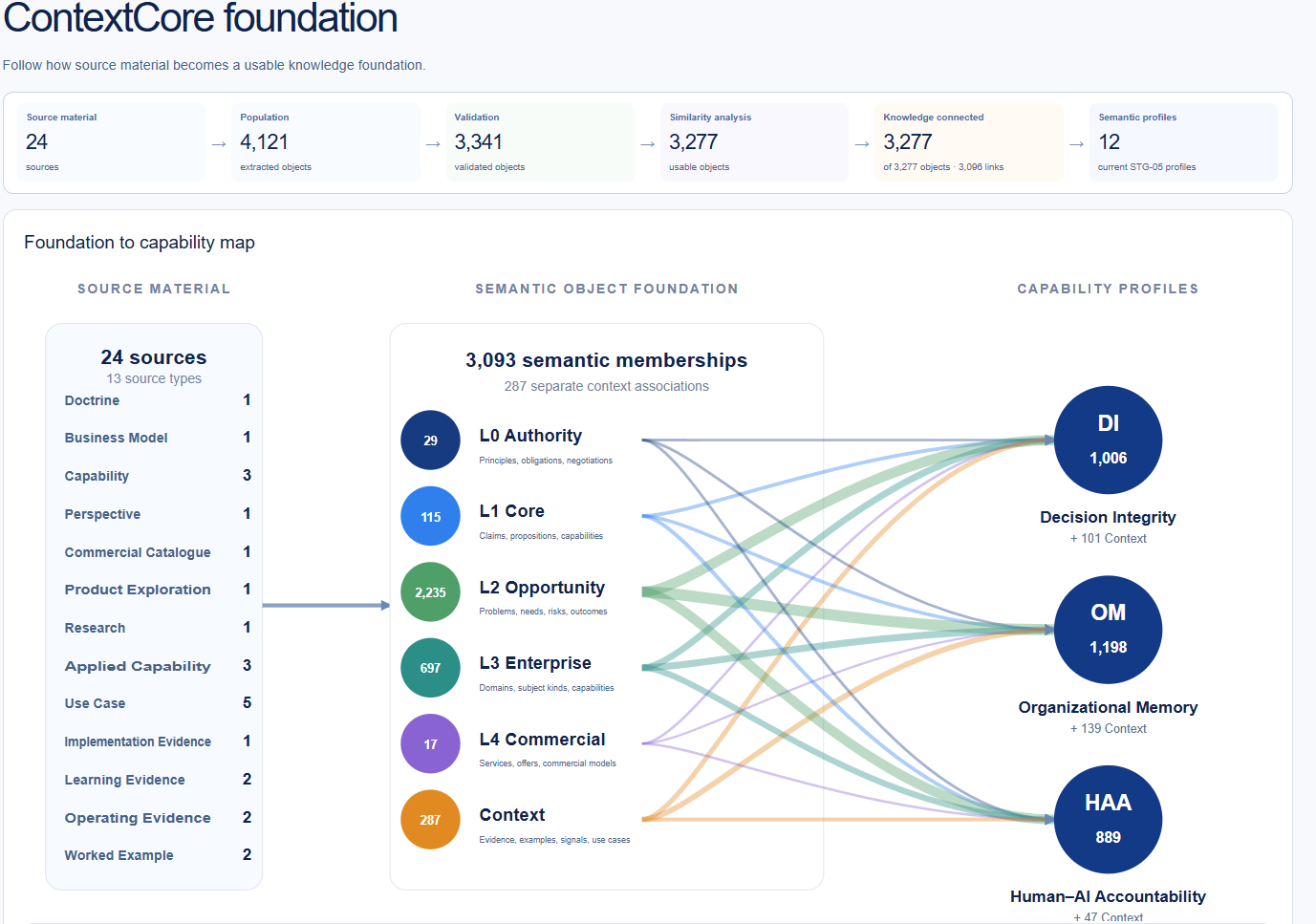
This view makes the source-to-foundation transformation inspectable, including the distinction between processing activity and governed results. Its counters are dated working values; it does not establish complete coverage, automatic verification, production readiness or runtime decision authority.
Membership-lineage view
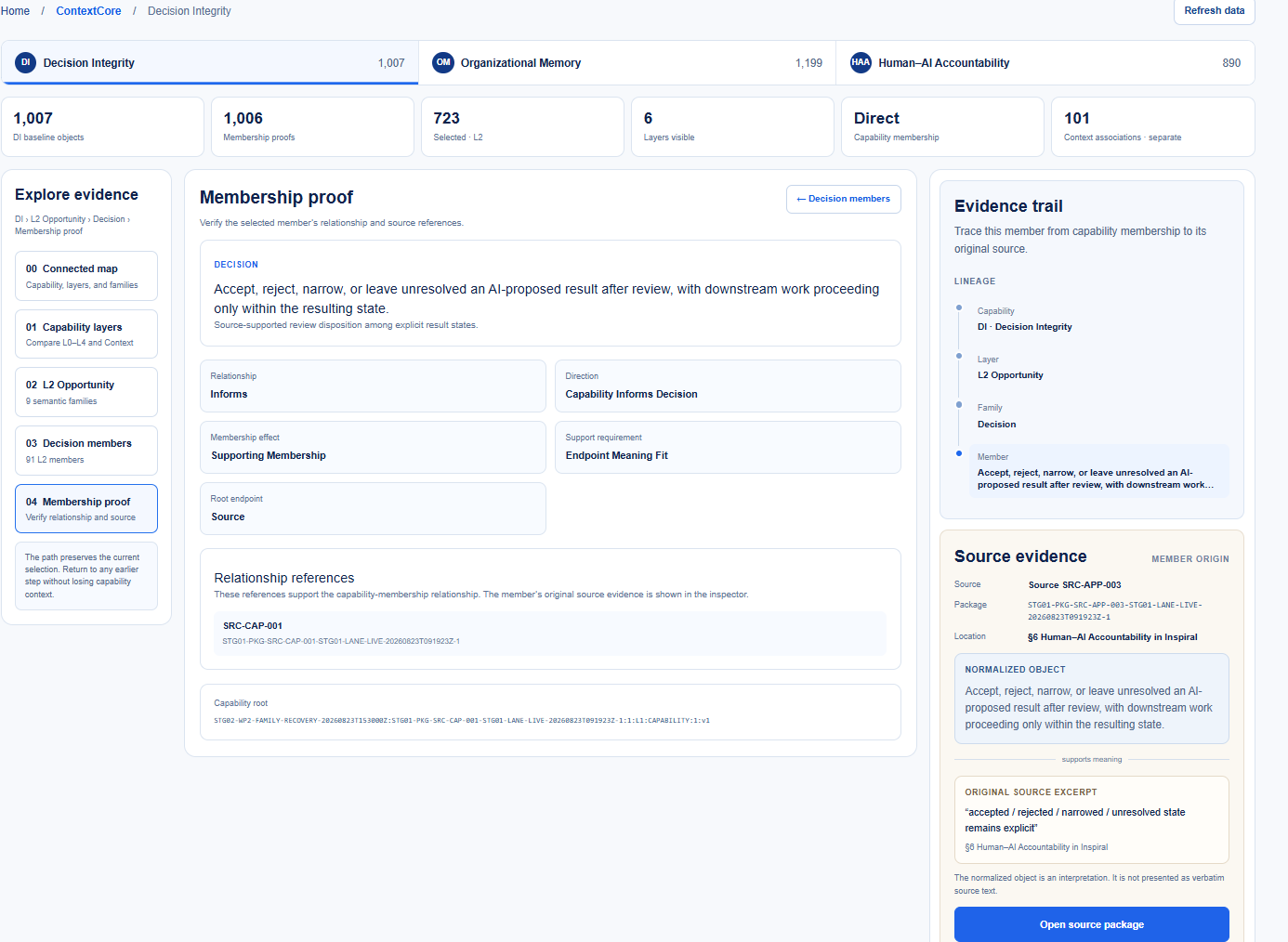
This view shows one selected Decision Integrity member within the L2 Opportunity layer and Decision family. It supports a bounded lineage path; it does not by itself prove every relationship, the underlying source evidence or complete family coverage.
Read together, the views show:
source material → bounded population → validation → governed relationships → capability membership → source evidence
What the current slice establishes
For this governed slice, completion means that selected source and package denominators are accounted for, semantic candidates are persisted or dispositioned, validation outcomes remain visible, Relationships and Edges reconcile, supporting context stays separate and capability membership has exact proof lineage. Later stages can consume the baseline without rebuilding it from raw source prose.
It does not mean that every possible source, relationship or interpretation has been resolved. ContextCore does not determine purpose-specific relevance, create a communication profile, generate an article or authorise a consequential state change. Those responsibilities belong to later Inspiral stages such as CanonLens and ContentFlight.
Why this matters for agentic systems
Without this foundation, a later task can mistake a plausible model response for authority, confuse similarity with a governed relationship, lose the evidence behind a claim, carry forward superseded state or invent a boundary when context is incomplete. ContextCore gives later agents a bounded answer to four questions: what is current, where did it come from, how is it connected and what may be done with it?
OpenAI and connected tools used in this fieldwork
The tools contributed different kinds of capacity to the ContextCore investigation; none independently created, verified or authorised the system.
| Tool | Contribution to ContextCore |
|---|---|
| ChatGPT Work with connected Notion context | Supported Inspiral problem synthesis, intent definition, high-level implementation planning, the Master Functional Specification, Functional Flow and first draft stage specifications. |
| Codex | Developed ContextCore end to end through repository inspection, implementation comparison, shared-adapter tracing, skill development, test review and remediation analysis. |
| OpenAI Developers | Provided implementation context for OpenAI agentic architecture, AI boundaries and bounded skill development. |
| Notion App | Held the source-data pages and working records from which source material, evidence and lineage were assembled. |
| Notion app/plugin | Retrieved governed specifications, implementation plans, stage definitions and source context used to guide and verify the work. |
| Supabase plugin | Supported inspection of persistent ContextCore data used by the dashboard, capability views and evidence drill-downs. |
| ChatGPT Sites | Supported ContextCore dashboard visualisation, Cytoscape graph display and drill-down from capability relationships toward source lineage. |
| Figma plugin and ChatGPT Product Design plugin | Supported dashboard design direction, product-flow definition and mockups grounded in available ContextCore data. |
Human review selected the evidence surfaces, resolved the boundary between ContextCore and CanonLens, checked claims against stage contracts and retained implementation and publication authority.
OPENAI CONTRIBUTION RECORD
Contribution: ChatGPT Work and connected Notion context supported Inspiral problem synthesis, intent definition and planning. The Notion App and plugin provided source data, specifications and implementation context. Codex supported end-to-end ContextCore development and remediation. OpenAI Developers guidance informed the agentic architecture and shared adapter. Supabase, ChatGPT Sites, Figma and Product Design tooling supported persistent-data review, dashboard visualisation, lineage presentation and interface planning.
Human authority: Ananda Krishna Marri selected the evidence, resolved semantic and stage boundaries, reviewed implementation and limitations, and retained implementation and publication authority.
Limitation: These contributions do not establish complete organisational coverage, universal correctness, production-wide maturity, autonomous authority or partnership.
Shiftby.pro is an independent fieldwork publication. References to tools describe how they were used in the work and do not imply endorsement, certification or partnership.
Boundary
This note describes the completed current ContextCore slice in the Inspiral agentic flow, not the full CanonLens or ContentFlight implementation. Counts, relationships, profile states and interface labels may change as the underlying data and implementation change.
Continue the fieldwork
The next question is how CanonLens turns governed capability knowledge into purpose-specific contextual meaning without rebuilding or weakening the ContextCore foundation.